
Wound care begins with
Equi-Solfen®
Types of superficial wounds
A wound is any disruption in the continuity of skin. Superficial skin wounds, such as lacerations and abrasions, are limited to the upper layers of the skin. Deeper wounds, such as punctures or avulsions (skin tears) can reveal important structures such as muscle, tendon, ligaments or bone. The wound location and the tissues involved are more critical than the overall appearance of the wound. Even small wounds can have serious complications, and it is always advisable to consult a veterinarian to determine the best treatment. Often this advice can be given over the phone. It is important that you describe the wound accurately. If you have any concerns about a wound, always consult your veterinarian.

Managing wounds
Wound cleansing: Clean wounds within 4-6 hours to reduce the risk of complication and infection. Flush the wound thoroughly with running water or saline. Care should be taken when applying ointments or pastes. If you have any concerns, consult your veterinarian.
Dressings: Apply a sterile, absorbent dressing as first aid. Apply a soft, sterile cotton pad to the wound and wrap with firm bandaging. After assessment, your vet will apply a dressing specific to the injury and provide advice about changing the dressing. Consult your veterinarian before applying an alternative dressing.
Minimise movement: Movement at the wound site can slow the process of healing. Immobilisation dressings or devices may be required to limit movement. Box rest may be required.
Safety: Frightened, lively or injured horses may make wound management difficult. Always ensure the safety of yourself and others before attempting to clean or dress a wound. Some horses may require sedation.
The only 4-in-1 solution for pain relief and wound care
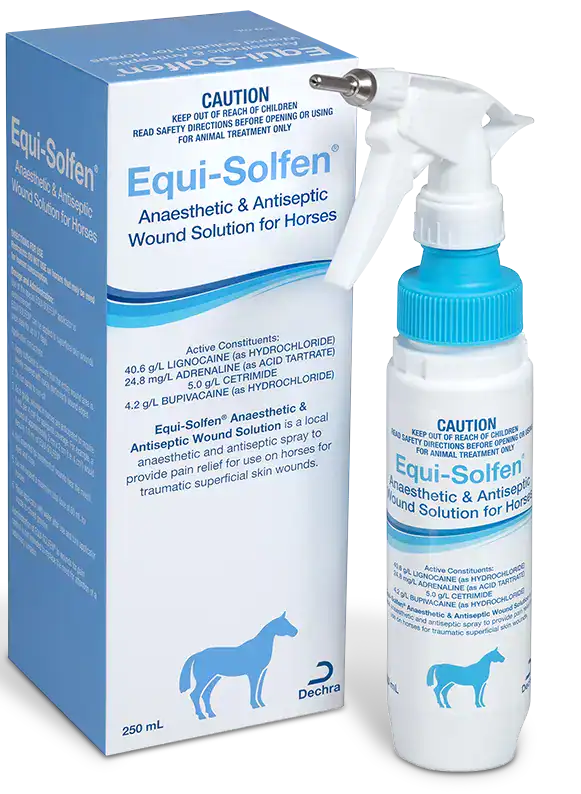
Equi-Solfen® anaesthetic and antiseptic spray provides 4-in-1 solution for pain relief and wound care for horses with superficial skin wounds. Administered once-daily for up to seven days, this ready-to-use, spray-on gel provides rapid and lasting relief from acute pain, reduces bleeding, protects against infection and assists in wound healing. Equi-Solfen® can be purchased from equestrian stores, produce stores, rural stores or veterinary clinics without a prescription. It is available in a handy 250 mL pack.

How Equi-Solfen® works
Equi-Solfen® contains lignocaine and bupivacaine, two local anaesthetics that block the nerve signals from damaged issue that are responsible for the sensation of pain, reducing the horse’s pain response; adrenaline, which constricts blood vessels on wounds, reducing blood loss, minimising stress and shock; and cetrimide, an antiseptic and surfactant that helps to start the healing process and protect against infection. Equi-Solfen® is specially formulated to help to seal and protect the skin wound for improved wound healing.

Applying Equi-Solfen®
Equi-Solfen® can be applied to superficial skin wounds once-daily for up to seven days.
- Ensure nozzle is finger tight.
- Loosen the nozzle in 2 half-turns counterclockwise to ensure correct spray pattern.
- To spray, hold applicator 10 cm away from the wound to be treated.
- Use a quick firm squeeze action to allow the product to foam on contact ensuring complete coverage of the wound.
- Apply 1 mL (one spray) of Equi-Solfen® per 4cm2 (i.e. 2 cm x 2 cm) of wound area.
- Cover the entire wound area with spray, particularly wound edges.
- DO NOT spray to run-off.
- DO NOT treat wounds near the mouth, eyes and nose.
- After use, remove applicator and spray remaining product back into the bottle.
- Replace blue transit cap.
- Rinse applicator with water by pumping water through the tubing.
- Wipe dry the applicator assembly, ready for next use.
- Store product and applicator assembly in a clean place, box or back into carton to prevent contamination.
Consult your veterinarian
Administration of Equi-Solfen® to wounds is not intended to replace the need for attention of a veterinarian. If you have any concerns about a wound, always consult your veterinarian. Deep wounds or those that are bleeding heavily require immediate veterinary attention. Bleeding can be controlled temporarily by applying Equi-Solfen® and a pressure bandage.
In addition, consult your veterinarian if:
- The wound reveals tissue, muscle, tendon, ligament or bone.
- The wound is close to a joint or tendon and leaking a clear discharge.
- The wound is inflamed (i.e. hot or swollen).
- The wound is infected (i.e. significant or offensive discharge).
- The wound is growing in size.
- The wound is not healing.
- Your horse has become lame or unsound.
- Any wound to the ears, nose or throat.
- Tissue within the wound becomes ‘proud’ (i.e. it stands out from the wound).
- Other questions or concerns you may have.
If veterinary attention is required, be assured that many wounds can be closed using sutures or staples. Your veterinarian may opt to leave the wound open or insert a drain into the wound to help release fluid during healing. Some wounds, such as ‘proud flesh’, may require surgery or specialist treatment at a veterinary hospital.
Download resources
Providing pain relief and wound care to horses with superficial skin wounds
Equi-Solfen® usage instructionsEqui-Solfen® registered labelEqui-Solfen® technical noteEqui-Solfen® safety data sheet